Behandlung mit Antidepressiva
Behandlung mit Antidepressiva
Die moderne Behandlung der Depression
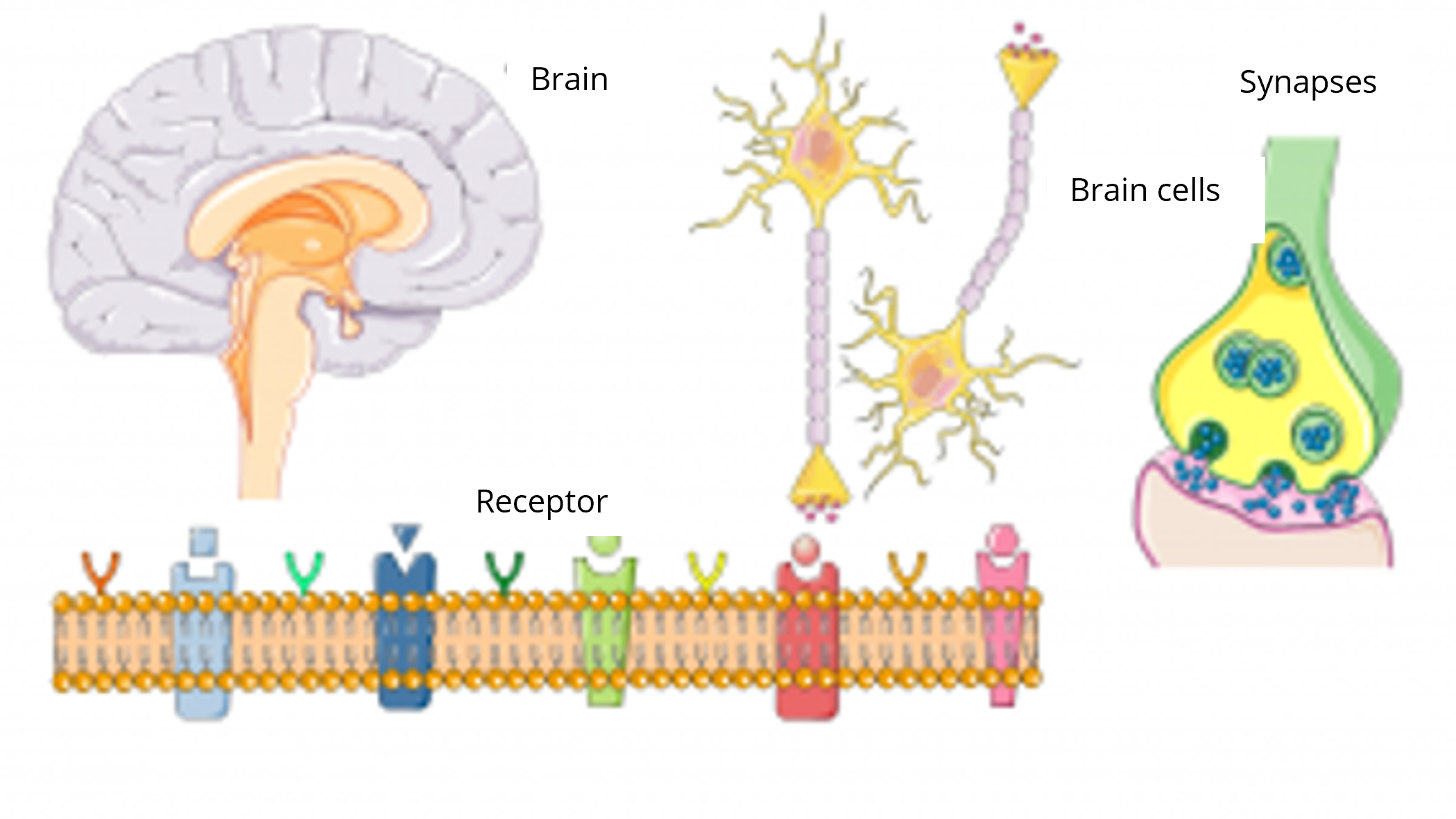
Im Jahr 2022 waren 8% der Bevölkerung wegen psychischen Problemen in Behandlung. Die Depression ist die am häufigsten auftretende psychische Erkrankung. 10% der Schweizer Bevölkerung weisen mittelschwere bis schwere Depressionssymptome auf. Frauen (12%) und junge Menschen (19%) sind häufiger betroffen als Männer (8%) und Personen ab 65 Jahren (4%).1 Auf dem Genom (Gesamtheit aller Träger der Erbinformation einer Zelle, wie Chromosomen, DNA, RNA) konnte die Wissenschaft bislang 44 Genorte identifizieren, die mit schweren Depressionen in Verbindung stehen.2 Epigenetische Veränderungen (vererbbare Chromosomen-Modifikationen ohne Veränderungen der DNA-Sequenz) bestimmen, ob die Depression wirklich ausbrich.3 Umwelteinflüsse bewirken unter anderem solche epigenetischen Veränderungen. Bei einer Depression kommt es zu Stoffwechselentgleisungen im Hirn. Dass der Stoffwechselhaushalt der Hirnzellen wieder ins Gleichgewicht kommt, ist das Ziel der medikamentösen Behandlung von Depressionen. Das menschliche Gehirn hat insgesamt 8.6·1010 Nervenzellen (86’000’000’000). Jede Nervenzelle ist über ungefähr 105 Synapsen (100’000) mit anderen Nervenzellen verbunden. Das neuronale Netzwerk des Menschen besitzt so zirka 8.6·1015 (8600’000’000’000’000) synaptische Verbindungen. Die Fortleitung des Impulses in der Hirnzelle ist ein elektrischer Vorgang. Der elektrische Impuls führt zur Ausschüttung eines Überträgerstoffs oder Hirnbotenstoffs (Neurotransmitter) in den Spalt zwischen den Hirnzellen (synaptischer Spalt). Es sind über 100 erregende und hemmende Neurotransmitter bekannt.

Wirkungsweise von Antidepressiva
- Effekte auf Hirnbotenstoff-Ebene und Rezeptor-Ebene, Andockstelle einer Zelle, die meistens an der der Zelloberfläche liegt. Wenn sich Hirnbotenstoffe an den Rezeptor binden, lösen sie ein Signal in der Zelle aus (Schlüssel=Botenstoff und Schloss=Rezeptor). Nur wenn beide zusammen passen, kommt es zur Reaktion wie Transport, Metabolismus (Abbau), Agonismus (Aktivierung), Antagonismus (Blockierung), Modulation (Veränderungen)
- Effekte auf Signalübertragung
- Effekt auf Genexpression (wie ein Gen zum Ausdruck kommt und in Erscheinung tritt)
- Effekte auf übergeordneter Ebene des Zentralen Nerven Systems (Modulation der Plastizität des Hirns, Neubildung von Hirnzellen, Beschaffenheit der Rezeptoren)
- Effekte auf Verhaltensebene (Stimmungsaufhellung, Aktivitätssteigerung, Normalisierung der Denkstörungen, Verminderung der Störungen des vegetativen Nervensystems)
Funktion der Neurotransmitter (Hirnbotenstoffe)
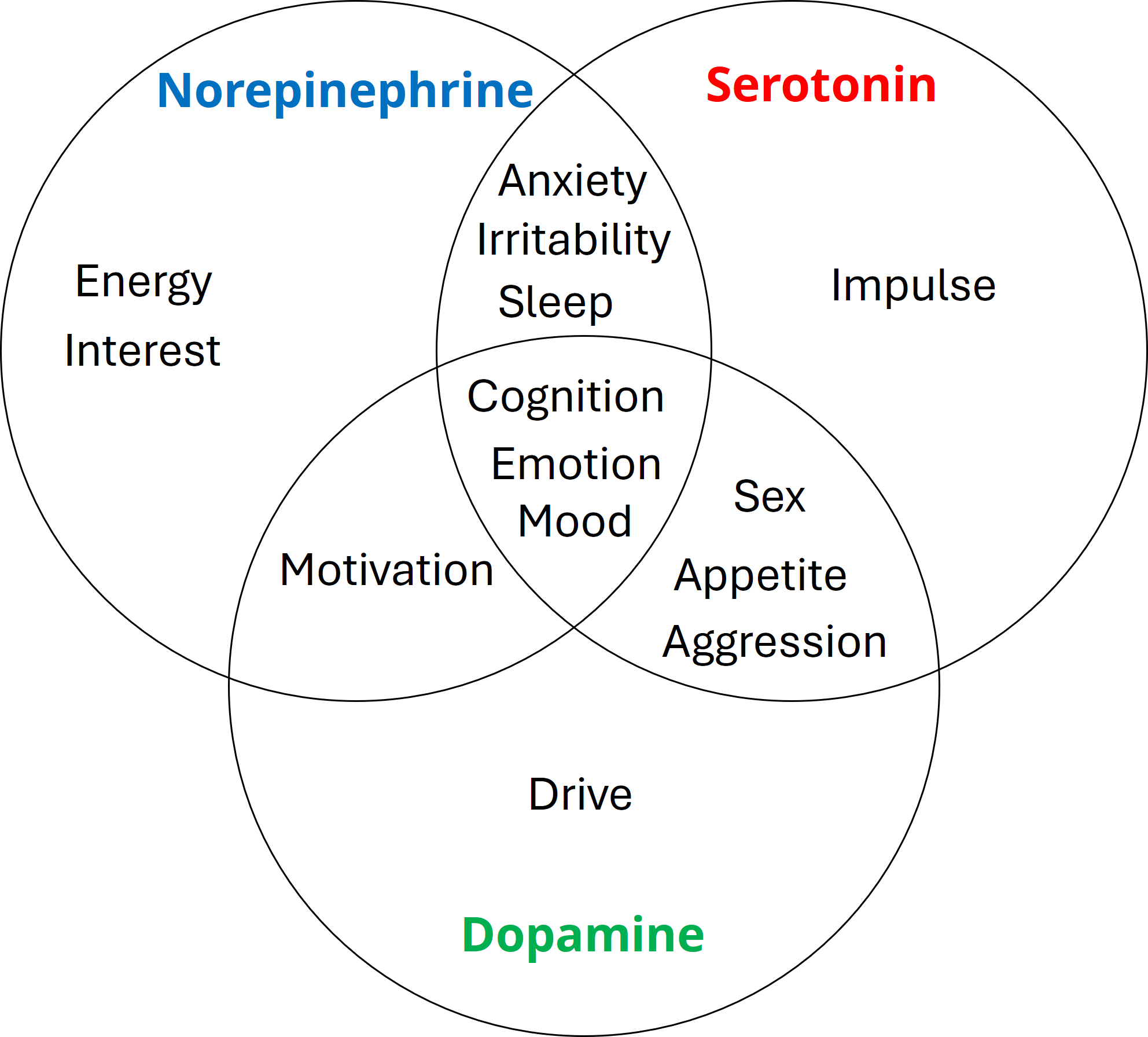
Serotonin (5-HT), Noradrenalin (NE), Dopamin (DA), γ-Aminobuttersäure (GABA), Acetylcholin (Ach), Histamin, Glutamat und andere Hirnbotenstoffe sind an der Stoffwechselstörung im Hirn beteiligt. Auch Störungen des Hormonhaushaltes (Adrenalin, körpereigenes Kortisol) spielen bei der Depression eine Rolle. GABA ist der wichtigste hemmende Botenstoff im Vorderhirn (Siehe Wirkung von Benzodiazepinen)
► Serotonin, Noradrenalin und Dopamin
Funktionen der Hirnbotenstoffe4

► Glutamat
Wirkung von Glutamat
Glutamat ist der wichtigste erregende (exzitatorische) Neurotransmitter. Mehr als die Hälfte aller Synapsen im Gehirn verwenden Glutamat als Transmitter. N-Methyl-D-Aspartat Antagonisten bzw. «Glutamat Rezeptor Blocker» wirken gegen die Exzitotoxizität (nervenschädigende Übererregung) durch den Hirnbotenstoff Glutamat, wirken zudem antioxidativ, entzündungshemmend und neuroprotektiv. Ketamin (Ketalar®), Esketamin (Spravato®), Memantin (Axura®, Ebixa®), Riluzol (Rilutek®), D-Cycloserin (Seromycin®), Minocyclin (Minocin®) und andere Substanzen bzw. Medikamente reduzieren bzw. verhindern die Schädigung der Hirnzellen durch Glutamat. Diese Medikamente sind Alternativen zu den Antidepressiva bei Therapieresistenz der Depression.
Einteilung der Antidepressiva
- Trizyklische Antidepressiva (TCA)
- Serotonin-Wiederaufnahmehemmer (S-RI)
- Clomipramin (Anafranil®)
- Noradrenalin-Wiederaufnahmehemmer (N-RI)
- Maprotilin (Ludiomil®)5, 6, Nortriptylin (Nortrilen®)5, 6
- Serotonin-/Noradrenalin-Wiederaufnahmehemmer (SN-MM)
- Amitriptylin (Saroten®), Doxepin (Sinquan®), Imipramin, (Tofranil®)5, 6, Trimipramin (Surmontil®)
- Serotonin-Wiederaufnahmehemmer (S-RI)
- Selektiver Serotonin-Wiederaufnahmehemmer (S-RI)
- Citalopram (Seropram®), Escitalopram (Cipralex®), Fluoxetin (Fluctine®), Fluvoxamin (Floxyfral®), Paroxetin (Deroxat®), Sertralin (Zoloft®)
- Selektiver Noradrenalin-/Serotonin-Wiederaufnahmehemmer (SN-RI)
- Duloxetin (Cymbalta®), Venlafaxin (Efexor®), Milnacipran (Milnaneurax®)6, 7
- Noradrenalin Multimodal (NMM)
- Mianserin (Tolvon®)
- Multimodales Antidepressivum (S-MM)
- Vortioxetin (Brintellix®)8
- Noradrenalin/spezifisches Serotonin Antidepressivum (SN-RAn)
- Mirtazapin (Remeron®)
- Selektiver Noradrenalin-Wiederaufnahmehemmer (N-RI)
- Reboxetin (Edronax®)
- Serotonin-Antagonist/- Wiederaufnahmehemmer (S-MM)
- Trazodon (Trittico®)
- Melatonin Multimodal (Mel-MM)
- Agomelatin (Valdoxan®)
- Glutamatmodulator
- Tianeptin (Tianeurax®, Stablon®)6, 7
- Riluzol (Rilutek®)
- Dopamin-Wiederaufnahmehemmer (D-RIRe)
- Bupropion (Wellbutrin XR®, Zyban®)
- Reversibler selektiver Monoaminooxidase A-Hemmer (SNRevEI)
- Moclobemid (Aurorix®)
- Monoaminooxidasehemmer (SN-MM)
- Tranylcypromin (Jatrosom N®)6, 7
- Glutamat Rezeptor Antagonist (Glu-RAn)
- Memantin (Axura®, Ebixa®)
- Donepezil (Aricept®)
- Galantamin (Reminyl®)
- Ketamine (Ketanest®)
- Esketamin (Ketanest® S, Spravato®)
- Partieller Agonist des Glycin-Koagonisten des Glutamatrezeptors
- Cycloserin (Seromycin®)
- Antioxidans, Glutamatmodulator, pro-inflammatorischer Zytokine Reduktor (IL-1, IL-6, IL-2, TNF-, IFN-γ), anti-inflammatorische Zytokine IL-10 Regulator, Serotonin-, Dopamin-, Serotonin-/Dopamintransporter Reduktor
- Minocyclin (Minocin®)
Neuroscience-based Nomenclature (NbN)9
| dopamine reuptake inhibitor and releaser (D-RIRe) | Dopamin-/Noradrenalin-Wiederaufnahmehemmer (NDRI) |
| Allosterischer Serotonin-Wiederaufnahmehemmer (ASRI) | |
| glutamate receptor antagonist (Glu-RAn) | Glutamat Rezeptor Antagonist |
| glutamate; yet to be determined (Glu) | Glutamatmodulator |
| melatonin multimodal (Mel-MM) | Melatonin-Agonist/Serotonin Antagonist |
| N-methyl-D-aspartate (NMDA) receptor antagonist (Glu-RAn) | N-Methyl-D-Aspartat Rezeptor Antagonist |
| norepinephrine multimodal (NMM) | Noradrenerges Antidepressivum mit Hemmung präsynaptischer α2-Rezeptor |
| norepinephrine reuptake inhibitor (N-RI) | Selektiver Noradrenalin-Wiederaufnahmehemmer (sNARI) |
| partial agonist of the glycine co-agonist of the glutamate receptor | Partieller Agonist des Glycin-Koagonisten des Glutamatrezeptors |
| serotonin multimodal (S-MM) | Multimodales Antidepressivum, Serotonin-Antagonist/- Wiederaufnahmehemmer (SARI) |
| serotonin, norepinephrine, dopamine multimodal enzyme inhibitor (SN-MM) | Monoaminooxidasehemmer (MAOI) |
| serotonin, norepinephrine, dopamine reversible enzyme inhibitor (SNRevEI) | Reversibler selektiver Monoaminooxidase A-Hemmer (MAO-A) (RIMA) |
| serotonin, norepinephrine multimodal (SN-MM) | Selektiver Noradrenalin-/Serotonin-Wiederaufnahme-hemmer (SNRI) |
| serotonin, norepinephrine receptor antagonist (SN-RAn) | Noradrenalin/spezifisches Serotonin Antidepressivum (NaSSA) |
| serotonin reuptake inhibitor (S-RI) | Selektiver Serotonin-Wiederaufnahmehemmer (SSRI) |
| tricyclic antidepressant (TCA) | Trizyklische Antidepressiva (TZA) |
1Storni M, Lieberherr R, Kaeser M, Schneider S. (2023). Schweizerische Gesundheitsbefragung 2022, Neuchâtel, Schweizerische Eidgenossenschaft, Eidgenössisches Departement des Innern (EDI), Bundesamt für Statistik (BFS).
2Wray NR et al. Genome wide association analyses identify 44 risk variants and refine the genetic architecture of major depression. Nat Genet. 2018 May;50(5):668-681.
3Klengel T, Binder EB. (2015) FKBP5 allele-specific epigenetic modification in gene by environment interaction. Neuropsychopharmacology. 2015 Jan;40(1):244-246.
4Modifiziert nach Healy D., McMonagle T. (1997). The enhancement of social functioning as a therapeutic principle in the management of depression. J Psychopharmacol, 11(4 Suppl)/1997, S. 25-31.
5In der Schweiz nicht mehr erhältlich.
6In Deutschland erhältlich.
7Keine Zulassung in der Schweiz durch Swissmedic.
8 Serotonin-Wiederaufnahmehemmer, Serotonin-1A-Rezeptoragonist, partieller Serotonin-1B-Rezeptorantagonist, Serotonin-1D-/3-/7-Rezeptorantagonist, Modulator des Serotonin, Noradrenalin , Dopamin , Histamin , Acetylcholin , GABA und Glutamat Systeme.
9Zohar J, Stahl S., Moller HJ, Blier P, Kupfer D, Correll C, Yamawaki S, Uchida H, Drago F, Goodwin G, Nutt D. 2019. NbN-2R – Neuroscience-based Nomenclature Second Edition – Revised. European College of Neuropsychopharmacology (ECNP).
Modern Treatment of Depression
In 2022, 8% of the population was receiving treatment for mental health issues. Depression is the most common mental illness. 10% of the Swiss population exhibits moderate to severe symptoms of depression. Women (12%) and young people (19%) are affected more frequently than men (8%) and people aged 65 and older (4%).1 Scientists have so far identified 44 genetic loci on the genome (the totality of all carriers of a cell’s genetic information, such as chromosomes, DNA, and RNA) that are associated with major depression. 2 Epigenetic changes (heritable chromosomal modifications without alterations to the DNA sequence) determine whether depression actually develops.3 Environmental influences, among other factors, cause such epigenetic changes. Depression leads to metabolic imbalances in the brain. The goal of pharmacological treatment for depression is to restore the metabolic balance of brain cells. The human brain has a total of 8.6 × 10¹⁰ nerve cells (86,000,000,000). Each nerve cell is connected to other nerve cells via approximately 10⁵ synapses (100,000). The human neural network thus has approximately 8.6 × 10¹⁵ (8,600,000,000,000,000) synaptic connections. The transmission of an impulse within a brain cell is an electrical process. The electrical impulse triggers the release of a neurotransmitter into the gap between the brain cells (synaptic cleft). Over 100 excitatory and inhibitory neurotransmitters are known.
How Antidepressants Work
- Effects at the level of neurotransmitters and receptors—a binding site on a cell, usually located on the cell surface. When neurotransmitters bind to the receptor, they trigger a signal within the cell (key = neurotransmitter and lock = receptor). Only when both fit together does a reaction occur, such as transport, metabolism (breakdown), agonism (activation), antagonism (blocking), or modulation (changes)
- Effects on signal transduction
- Effects on gene expression (how a gene is expressed and manifests itself)
- Effects at the higher level of the central nervous system (modulation of brain plasticity, neurogenesis, receptor properties)
- Effects at the behavioral level (improved mood, increased activity, normalization of thought disorders, reduction of autonomic nervous system disorders)
Function of neurotransmitter
Serotonin (5-HT), norepinephrine (NE), dopamine (DA), γ-aminobutyric acid (GABA), acetylcholine (Ach), histamine, glutamate, and other neurotransmitters are involved in metabolic disturbances in the brain. Hormonal imbalances (adrenaline, endogenous cortisol) also play a role in depression. GABA is the most important inhibitory neurotransmitter in the forebrain (see Effects of Benzodiazepines).
► Serotonin, Norepinephrine and Dopamine
Function of neurotransmitter4
► Glutamate
Effect of Glutamate
Glutamate is the most important excitatory neurotransmitter. More than half of all synapses in the brain use glutamate as a transmitter. N-methyl-D-aspartate (NMDA) antagonists, or “glutamate receptor blockers,” counteract excitotoxicity (nerve-damaging overexcitation) caused by the neurotransmitter glutamate; they also have antioxidant, anti-inflammatory, and neuroprotective effects. Ketamine (Ketalar®), esketamine (Spravato®), memantine (Axura®, Ebixa®), riluzole (Rilutek®), D-cycloserine (Seromycin®), minocycline (Minocin®), and other substances or medications reduce or prevent damage to brain cells caused by glutamate. These medications are alternatives to antidepressants in cases of treatment-resistant depression.
Classification of Antidepressants
- Tricyclic Antidepressants (TCAs)
- Serotonin Reuptake Inhibitors (S-RI)
- Clomipramine (Anafranil®)
- Norepinephrine reuptake inhibitors (N-RI)
- Maprotiline (Ludiomil®), Nortriptyline (Pamelor®)
- Serotonin/norepinephrine reuptake inhibitors (SN-MM)
- Amitriptyline (Elavil®), doxepin (Sinequan®, Sinelor®), imipramine (Tofranil®), trimipramine (Surmontil®)
- Serotonin Reuptake Inhibitors (S-RI)
- Selective serotonin reuptake inhibitors (S-RI)
-
- Citalopram (Celexa®), escitalopram (Lexapro®), fluoxetine (Prozac®), fluvoxamine (Luvox®), paroxetine (Paxil®), sertraline (Zoloft®)
- Selective norepinephrine/serotonin reuptake inhibitors (SN-RI)
-
- Duloxetine (Cymbalta®), venlafaxine (Effexor®), milnacipran (Toledomin®, Ixel®, Savella®)
- Multimodal norepinephrine (NMM)
-
- Mianserin (Lerivon®)
- Multimodal antidepressant (S-MM)
-
- Vortioxetine (Trintellix®)5
- Norepinephrine/Specific Serotonin Antidepressant (SN-RAn)
-
- Mirtazapine (Remeron®)
- Selective Norepinephrine Reuptake Inhibitor (N-RI)
-
- Reboxetine (Edronax®, Norebox®)
- Serotonin antagonist/reuptake inhibitor (S-MM)
-
- Trazodone (Desyrel®, Oleptro®)
- Melatonin multimodal (Mel-MM)
-
- Agomelatine (Valdoxan®)
- Glutamate modulator
-
- Tianeptine (Coaxil®, Stablon®, Tatinol®)
-
- Riluzole (Rilutek®, Exservan®, Tiglutik®)
- Dopamine reuptake inhibitor (D-RIRe)
-
- Bupropion (Aplenzin®, Wellbutrin XR®, Zyban®)
- Reversible selective monoamine oxidase A inhibitor (SNRevEI)
-
- Moclobemide (Aurorix®, Arima®, Manerix®)
- Monoamine oxidase inhibitor (SN-MM)
-
- Tranylcypromine (Parnate®)
- Glutamate receptor antagonist (Glu-RAn)
-
- Memantine (Namenda®)
- Donepezil (Aricept®, Memac®)
- Galantamine (Razadyne®)
- Ketamine (Ketanest®, Ketalar®)
- Esketamine (Spravato®)
- Partial agonist of the glycine co-agonist of the glutamate receptor
-
- Cycloserine (Seromycin®)
- Antioxidant, glutamate modulator, pro-inflammatory cytokine reducer (IL-1, IL-6, IL-2, TNF-, IFN-γ), anti-inflammatory cytokine IL-10 regulator, serotonin, dopamine, and serotonin/dopamine transporter reducer
- Minocycline (Minocin®, Arestin®, Solodyn®, Minolira®)
Neuroscience-based Nomenclature (NbN)6
|
Dopamine reuptake inhibitor and releaser (D-RIRe) |
Dopamine/Norepinephrine Reuptake Inhibitor (NDRI) |
|
|
Allosteric Serotonin Reuptake Inhibitor (ASRI) |
|
Glutamate receptor antagonist (Glu-RAn) |
Glutamate Receptor Antagonist |
|
Glutamate; yet to be determined (Glu) |
Glutamate Modulator |
|
Melatonin multimodal (Mel-MM) |
Melatonin Agonist/Serotonin Antagonist |
|
Norepinephrine multimodal (NMM) |
Noradrenergic antidepressant with presynaptic α2-receptor inhibition |
|
Norepinephrine reuptake inhibitor (N-RI) |
Selective norepinephrine reuptake inhibitor (sNARI) |
|
Partial agonist of the glycine co-agonist of the glutamate receptor |
Partial agonist of the glycine coagonist of the glutamate receptor |
|
Serotonin multimodal (S-MM) |
Multimodal antidepressant, serotonin antagonist/reuptake inhibitor (SARI) |
|
Serotonin, norepinephrine, dopamine multimodal enzyme inhibitor (SN-MM) |
Monoamine oxidase inhibitor (MAOI) |
|
Serotonin, norepinephrine, dopamine reversible enzyme inhibitor (SNRevEI) |
Reversible selective monoamine oxidase A inhibitor (MAO-A) (RIMA) |
|
Serotonin, norepinephrine multimodal (SN-MM) |
Selective norepinephrine/serotonin reuptake inhibitor (SNRI) |
|
Serotonin, norepinephrine receptor antagonist (SN-RAn) |
Norepinephrine/specific serotonin antidepressant (NaSSA) |
|
Serotonin reuptake inhibitor (S-RI) |
Selective serotonin reuptake inhibitor (SSRI) |
|
Tricyclic antidepressant (TCA) |
|
1Storni M, Lieberherr R, Kaeser M, Schneider S. (2023). Schweizerische Gesundheitsbefragung 2022, Neuchâtel, Schweizerische Eidgenossenschaft, Eidgenössisches Departement des Innern (EDI), Bundesamt für Statistik (BFS).
2Wray NR et al. Genome wide association analyses identify 44 risk variants and refine the genetic architecture of major depression. Nat Genet. 2018 May;50(5):668-681.
3Klengel T, Binder EB. (2015) FKBP5 allele-specific epigenetic modification in gene by environment interaction. Neuropsychopharmacology. 2015 Jan;40(1):244-246.
4Modifiziert nach Healy D., McMonagle T. (1997). The enhancement of social functioning as a therapeutic principle in the management of depression. J Psychopharmacol, 11(4 Suppl)/1997, S. 25-31.
5Serotonin-Wiederaufnahmehemmer, Serotonin-1A-Rezeptoragonist, partieller Serotonin-1B-Rezeptorantagonist, Serotonin-1D-/3-/7-Rezeptorantagonist, Modulator des Serotonin, Noradrenalin , Dopamin , Histamin , Acetylcholin , GABA und Glutamat Systeme.
6Zohar J, Stahl S., Moller HJ, Blier P, Kupfer D, Correll C, Yamawaki S, Uchida H, Drago F, Goodwin G, Nutt D. 2019. NbN-2R – Neuroscience-based Nomenclature Second Edition – Revised. European College of Neuropsychopharmacology (ECNP).
